
DISE
Disaggregation of Income Statement Expenses | ASU 2024-03
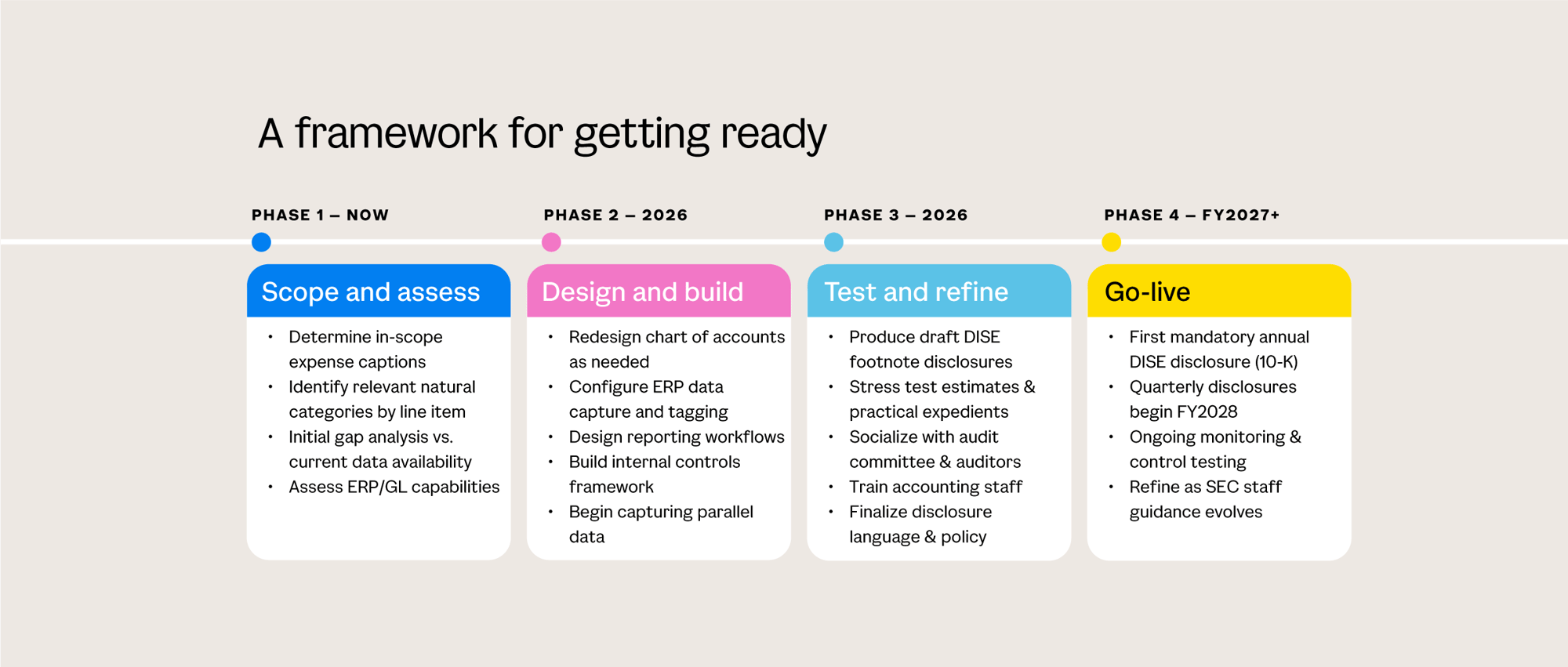
DISE readiness isn't a single workstream—it spans technical accounting interpretation, data architecture, systems configuration, and financial reporting process design. As a pure advisory firm with no audit independence constraints, we can go as deep as the work requires.
What you need to know about DISE
Does DISE apply to you?
- Required for all Public Business Entities (PBEs)
- All SEC registrants (NYSE, NASDAQ, etc.)
- Companies with securities traded on OTC markets
- Subsidiaries included in a parent's SEC filing (e.g., S-X Rule 3-05 or 3-09)
- Companies in the process of an IPO or going public
- Private companies being acquired by a public company if their financials must be filed with the SEC
Why are many companies not ready?
- Cross-functional coordination: Finance, HR, IT, operations, and procurement all need to align. In decentralized or multi-segment companies, this coordination effort can be substantial.
- Retrospective data requirements: If you elect retrospective adoption, you'll need comparative data going back to 2025—data many companies have never tracked. Starting now is essential.
- Data & systems gaps: Most ERP and GL systems weren't designed to tag expenses by natural category. Chart of accounts restructuring and new data capture fields will likely be required.
- Internal controls & SOX implications: New disclosures require new controls around data accuracy and completeness. ICFR and SOX implications need to be assessed and documented before you go live.
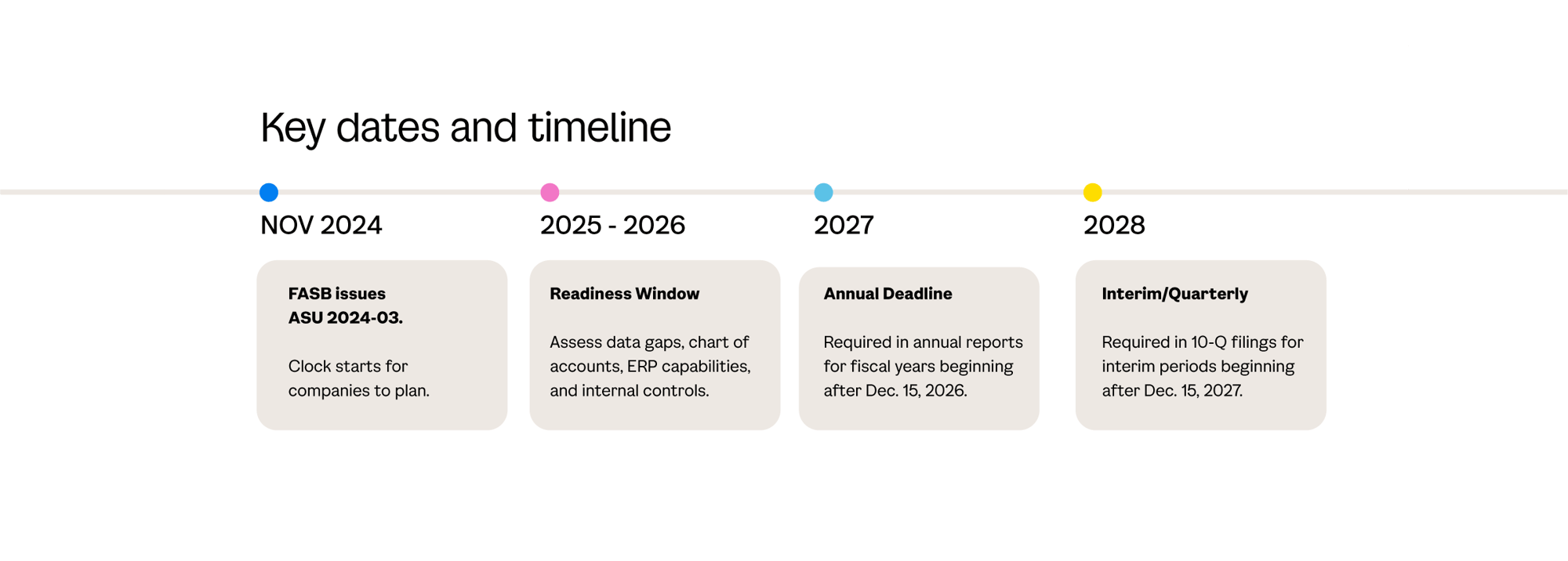
The time to start is now
- FY2027: Annual deadline (public cos.)
- FY2028: Quarterly (interim) deadline
- Anytime: Early adoption permitted
How Embark can help
Draft the tabular footnote disclosure, develop the supporting disclosure language, and build tie-out procedures that hold up under auditor scrutiny.
For companies preparing for an IPO, M&A, or SPAC, DISE compliance is increasingly part of the story. We can scope and sequence the work alongside your broader transaction preparation.
DISE FAQs
What is DISE?
DISE—Disaggregation of Income Statement Expenses—is a new FASB standard (ASU 2024-03) requiring public companies to pull back the curtain on broad expense line items like COGS and SG&A. Right now, a company can report $500M in "SG&A" and investors are largely left guessing what's in it. Under DISE, that changes.
Companies will need a footnote table showing exactly how much of that figure was employee compensation, depreciation, inventory purchases, and so on. The income statement face doesn't change, but the footnotes get a lot more specific, and getting them right takes real work on data, systems, and process.
What are the 5 required natural expense categories under DISE?
- Every relevant income statement line item needs to be broken out into these five categories (where applicable):
1. Purchases of inventory — raw materials and goods bought during the period.
2. Employee compensation — salaries, wages, benefits, and stock-based comp.
3. Depreciation — PP&E wear-and-tear charges.
4. Intangible asset amortization — including capitalized software.
5. DD&A / depletion — depreciation, depletion, and amortization tied to oil-and-gas or other extractive activities.
Do private companies have to comply with DISE?
Does DISE apply to companies preparing for an IPO?
Does DISE apply to subsidiaries of public companies?
What if a private company is being acquired by a public company?
When is the DISE compliance deadline for public companies?
When do quarterly DISE disclosures become required?
Quarterly (interim) disclosures in 10-Q filings are required for interim periods beginning after December 15, 2027—effectively FY2028 for most companies.
Trusted by leading companies
%20(17).png)
%20(2).png)

%20(6).png)


%20(8).png)
%20(11).png)

%20(22).png)

.png)
%20(28).png)
%20(4).png)
%20(15).png)
%20(18).png)
%20(20).png)

Experienced DISE advisors
Client satisfaction that speaks for itself
Our client satisfaction scores are more than 70% higher than the industry average — here’s why:
Our company brought in three Embark consultants, who have become a seamless part of our team and have served as crucial resources. As our team and company have experienced rapid growth and have undertaken several significant projects, the Embark consultants have done more than just plug the gaps, bringing in fresh perspectives and a wealth of knowledge to improve processes, create automations, and strengthen financial reporting. They learned the business quickly and have become go-to assets on our team.
Nearly every Embarker we have worked with has been outstanding. They are professional, incredibly smart, and charismatic.
Excellent team to partner with. Thoughtful, analytical, and solutions oriented. They approach projects strategically and apply the latest technology and software platforms to drive efficient, practical outcomes. I highly recommend them.
We are able to develop and implement solutions timely with our consultants which is more than great. Embark is helping us leverage technology to become more efficient.
Embark is already ready and able to help us when needed. They have the appropriate knowledge, expertise and resources to assist with all our technical accounting needs.
Embark has consistently provided a highly knowledgeable group of finance professional that are an absolute pleasure to work with!
The Embark team is easy to work with and very knowledgeable. They go above and beyond, and I am thankful for the relationships I have built with each person I have had the privilege of working with.
From top down, Embark has been fantastic. Have some of the brightest team members you'll ever encounter and they blend right into great cultures. They are highly engaged and always looking for ways to help improve your business!!
Get the insights business leaders rely on
From guides and checklists to podcasts, our resources help you prepare
for audits, optimize cash flow, and prepare for IPOs with confidence.
From Standard to Disclosure: Building Your DISE Implementation Roadmap
Read the blog

DISE Is Coming: What Public Companies Need to Know About the New Expense Disaggregation Standard
Read the blog
Building Your DISE Roadmap
Play episode
Why DISE Changes Everything
Play episode
Tell us what you need help with
All Embark solutions begin with a conversation. Fill out this form and one of our advisors will follow up with a call. We can then better understand your needs and craft the right solution for your organization.